LoRaWAN vs 4G: Choosing the Best IoT Connectivity Australia for Remote Sensor Networks
A sensor that cannot send data is just a logger sitting in a paddock, pump shed, fridge, mine site or culvert. The hardware may be accurate. The dashboard may look sharp. But the real test is simple: can the system deliver the right data, at the right interval, without constant site visits?
That question sits at the heart of the LoRaWAN vs 4G decision. Both technologies can support remote monitoring, but they solve different problems. 4G and NB-IoT sensors connect directly to a mobile network. LoRaWAN sensors usually connect through a nearby gateway, which then sends data to the internet.
For IoT connectivity Australia presents a mixed set of conditions: dense cities, large farms, coastal infrastructure, remote industrial sites, hilly terrain, metal sheds, underground pits and areas with patchy mobile reception. A good remote sensor network design starts with those conditions, not with the newest device on a spec sheet.
How 4G and LoRaWAN monitoring systems work
A 4G sensor contains a cellular modem and SIM or eSIM. It talks directly to a mobile carrier network, much like a phone does. Depending on the device and network, it may use 4G LTE, Cat-M1 or NB-IoT.
NB-IoT sits within the cellular family but is designed for low-power, low-data devices. It is often a better match than full 4G for simple telemetry, such as a level reading every hour or a temperature reading every 15 minutes.
A LoRaWAN sensor works differently. It sends small packets of data over long-range, low-power radio to a LoRaWAN gateway. The gateway then forwards that data to the internet using Ethernet, Wi-Fi, 4G, fibre or another backhaul connection.
The key difference is ownership of the local network.
With 4G or NB-IoT, each sensor relies on the carrier network. With LoRaWAN, the site can run its own local radio network through one or more gateways.
That sounds subtle, but it affects cost, battery life, coverage, setup time and reliability.
The strengths and weaknesses of 4G and NB-IoT sensors
Standalone cellular sensors are often the fastest way to get monitoring online. Install the sensor, activate the SIM, check reception and start sending data.
That simplicity is valuable.
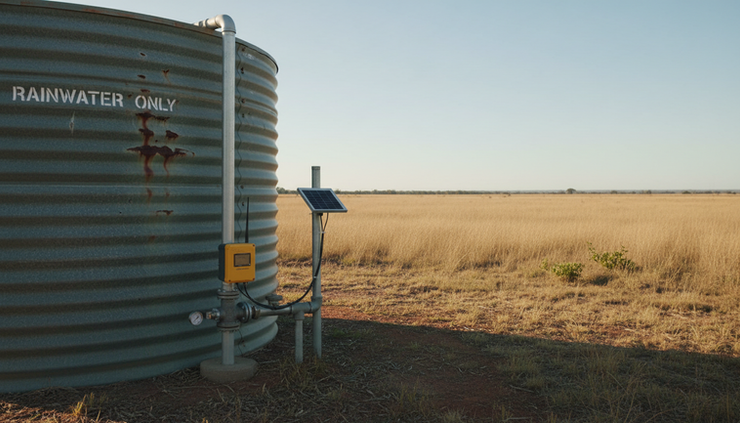
A single 4G level sensor on a rainwater tank does not need a gateway. A refrigerated trailer with GPS and temperature monitoring can report from different locations. A pump station near a highway may already have strong mobile coverage, so a direct cellular device makes sense.
Where 4G works well
4G is a good fit when the device needs to send more than tiny packets of data. That might include:
Camera snapshots from a construction site
Frequent vibration readings from machinery
GPS tracking for mobile assets
Alarm data that must be sent with low delay
Remote configuration updates
Sites with only one or two monitoring points
4G also suits mobile equipment. A gateway-based design does not help much if the asset keeps moving out of range. For example, a diesel generator that travels between temporary worksites is often better served by a cellular tracker than by a fixed LoRaWAN setup.
Where NB-IoT fits better than full 4G
NB-IoT can be a strong choice for small, infrequent messages. It usually aims for lower power use than full 4G and can perform better in difficult radio conditions, such as some meter pits or utility cabinets, where network support exists.
Good NB-IoT use cases include:
Water meter readings
Waste bin fill levels
Soil moisture probes in covered areas
Cold storage temperature checks
Basic flood or level alarms
The trade-off is data rate and flexibility. NB-IoT is not designed for large files, live video or constant streaming. It also depends on carrier support and coverage at the exact location.
The weak points of standalone cellular sensors
The main weakness is cost per device over time. Each sensor usually needs a SIM or carrier data plan. For one device, that may be fine. For 200 sensors on one property, it can become expensive and harder to manage.
Power use can also be higher. A 4G device may need a larger battery, solar panel or mains power, especially if it sends data often. In fringe coverage areas, devices may burn more energy trying to stay connected.
Coverage is the other practical issue. A phone showing one bar near the gate does not prove that a sensor inside a steel shed, valve pit or gully will connect reliably. Site testing matters.
The strengths and weaknesses of LoRaWAN gateways and sensors
LoRaWAN was built for low-power, long-range sensor communications. It does not try to replace Wi-Fi or 4G. It shines when many devices need to send small amounts of data over a local area.
A LoRaWAN sensor might run on batteries for a long period because it sleeps most of the time and only wakes to send compact messages. The gateway handles the internet connection for the whole group.
Where LoRaWAN works well
LoRaWAN is well suited to fixed monitoring across a site, farm, campus, utility area or industrial facility.
Common examples include:
Soil moisture sensors across crop blocks
Tank level sensors on multiple tanks
Gate, shed and bore pump status monitoring
Weather stations and rainfall gauges
Fridge and cool room temperature sensors
Air quality sensors across a council area
Flood level sensors along drains and creeks
If the sensors stay within radio range of a gateway and only need to send small readings, LoRaWAN can be very cost-effective.
The gateway changes the economics. Instead of paying for a cellular plan on every sensor, the site may only need backhaul for the gateway. That backhaul could even be 4G, which means LoRaWAN and 4G can work together rather than compete.

The weak points of LoRaWAN
LoRaWAN is not ideal for high data volumes. It is built for short messages, not images, audio, large diagnostics files or second-by-second telemetry.
Gateway placement also matters. Hills, dense vegetation, metal structures and poor antenna mounting can reduce range. A gateway in the wrong spot can create blind zones. Good installs often need basic radio planning, testing and suitable antennas.
The system also adds one more piece of infrastructure. If the gateway loses power or internet backhaul, the sensors may not be able to report until it comes back online. Some designs can buffer data, but alerting will still suffer during an outage.
For small deployments, the gateway may be overkill. If only one sensor is needed at a site with good mobile coverage, cellular is often simpler.
A practical comparison of LoRaWAN and 4G
Factor | 4G or NB-IoT standalone sensor | LoRaWAN gateway with multiple sensors |
Best for | One-off devices, mobile assets, higher data needs | Many fixed sensors sending small readings |
Internet connection | Built into each sensor through the carrier network | Gateway connects to the internet, sensors talk to gateway |
Power use | Can be higher, especially with frequent reporting or weak signal | Often very low for sensors |
Data volume | Better for larger or more frequent data | Best for small packets |
Coverage model | Depends on carrier coverage at each sensor | Depends on local gateway coverage and backhaul |
Scaling cost | SIM or plan per sensor can add up | Gateway cost upfront, lower per-sensor communications cost |
Setup effort | Usually simpler for a small number of devices | Needs gateway placement and radio testing |
Mobility | Good for moving assets | Best for fixed assets |
The most useful way to frame the choice is not “Which technology is better?” It is “Where is the network edge?”
With cellular, the network edge is each sensor. With LoRaWAN, the network edge is the gateway.
That difference shapes the whole project.
When to choose a standalone 4G or NB-IoT sensor
Choose a standalone cellular sensor when the job is small, mobile, data-heavy or spread across sites that do not share a useful local network.
A single tank sensor at a remote depot is a good example. If there is reliable mobile coverage and no other sensors nearby, a 4G or NB-IoT device keeps the setup clean. There is no gateway to mount, power or protect.
A mobile cold chain example makes the point even clearer. A refrigerated van carrying produce from a regional packhouse to retail stores needs to report temperature and location while moving. LoRaWAN coverage from one gateway will not follow the van down the highway. A cellular device is the better option.
Standalone cellular also suits temporary monitoring. A construction team may need noise, dust or vibration monitoring on a site for a few months. If the device needs to send richer data and the site has good coverage, 4G keeps the deployment flexible.
NB-IoT becomes attractive when the readings are small and battery life is a priority. For example, a council may monitor water levels in selected pits where mobile coverage supports NB-IoT. The sensor can send simple level readings and alarms without needing a nearby gateway.
Choose standalone 4G or NB-IoT when:
There are only one or two sensors at the location
The asset moves between sites
The sensor needs to send larger data payloads
A carrier network is reliable at the sensor position
Fast deployment matters more than lowest per-device running cost
Installing and maintaining a gateway would add unnecessary work

When to choose a LoRaWAN gateway with multiple sensors
Choose LoRaWAN when many fixed sensors sit within a defined area and only need to send small data packets.
A farm is a classic example. One gateway on a high point may collect readings from soil moisture probes, tank level sensors, pump monitors, weather stations and gate sensors. The gateway might use 4G backhaul if the farmhouse has no fixed internet. The sensors avoid individual SIM plans, and the farm gains a single remote sensor network across key assets.
A water utility might use LoRaWAN across a treatment plant or reservoir site. Sensors can monitor valve states, tank levels, flow pulses and equipment room temperature. The site already has power and a secure place to mount a gateway, so the network can support many devices at a low per-sensor communication cost.
A local council could use LoRaWAN for flood monitoring across a cluster of drains and creeks. Gateways mounted on suitable buildings or poles can collect readings from level sensors. If a sensor only sends periodic height readings and alarm thresholds, LoRaWAN is a natural match.
Cold storage is another useful case. A large warehouse may need dozens of temperature sensors across rooms, racks and loading areas. Cellular sensors in every room would be costly and may struggle inside the building. A well-planned LoRaWAN network with indoor gateways can collect frequent readings without a SIM in every device.
Choose a LoRaWAN gateway with multiple sensors when:
Several sensors are located across one site or nearby sites
Devices are fixed, not moving through wide areas
Readings are small, such as level, temperature, humidity, state or pulse counts
Low sensor power use matters
You want to reduce SIM management across many devices
You can place gateways in useful locations with power and backhaul
You need control over local coverage
Real-world examples that show the difference
A cattle property in regional Australia may need water tank monitoring over several kilometres. If there are many tanks, troughs and pumps within radio reach of high points, LoRaWAN can make sense. A small number of gateways can collect data from many low-power sensors. If one isolated bore sits far outside the gateway coverage but has mobile signal, that bore may use NB-IoT or 4G instead.
A mining contractor may monitor high-value mobile equipment across different sites. The assets move, and the data may include engine hours, GPS position, fault codes and utilisation. Cellular is usually the cleaner option because every asset needs its own wide-area connection.
A vineyard may use LoRaWAN for soil moisture, frost monitoring and weather data across blocks. The readings are small, the sensors are fixed, and battery life matters. If the same business wants camera images from a gate entrance, that specific device may use 4G because image data is too heavy for LoRaWAN.
A regional council may combine both. LoRaWAN can cover clusters of environmental sensors in parks, depots or flood-prone areas. Standalone NB-IoT sensors can fill gaps where only one asset needs monitoring and building a gateway site makes little sense.
This hybrid approach is common. The best design often uses cellular for backhaul or isolated assets, and LoRaWAN for dense groups of low-data devices.

The decision comes down to coverage, data, power and scale
Before choosing hardware, answer four practical questions.
How many sensors will be installed in the same area?
For one or two sensors, 4G or NB-IoT is often simpler. For ten, fifty or hundreds of fixed sensors, LoRaWAN becomes more attractive.
How much data will each device send?
Small readings suit LoRaWAN and NB-IoT. Larger files, frequent diagnostics, images and mobile tracking point towards 4G.
What power is available?
Mains power opens more options. Battery-only sites need careful design. LoRaWAN sensors often perform well in low-power roles, while 4G devices may need larger batteries or solar support.
What coverage exists at the real sensor location?
Do not rely on coverage maps alone. Test at the mounting height, inside the enclosure, near the pit lid, behind the tank or wherever the device will actually sit.
For LoRaWAN, test gateway position and sensor signal quality. For cellular, test the target network and technology, including NB-IoT if that is the planned path.
A simple rule of thumb
Use standalone 4G or NB-IoT when each sensor needs its own wide-area connection, the asset moves, the data is richer or the deployment is small.
Use LoRaWAN with a gateway when many fixed sensors need to send small readings across a property, facility or local area.
Use both when the site design calls for it. A gateway may use 4G for internet backhaul while dozens of LoRaWAN sensors report through it. A few isolated cellular sensors can also sit alongside a larger LoRaWAN network.
The right choice is the one that keeps data flowing with the least power, cost and maintenance for the job. Start with the site, the number of sensors and the type of data. The technology decision will usually become clear from there.


.png)
Comments